

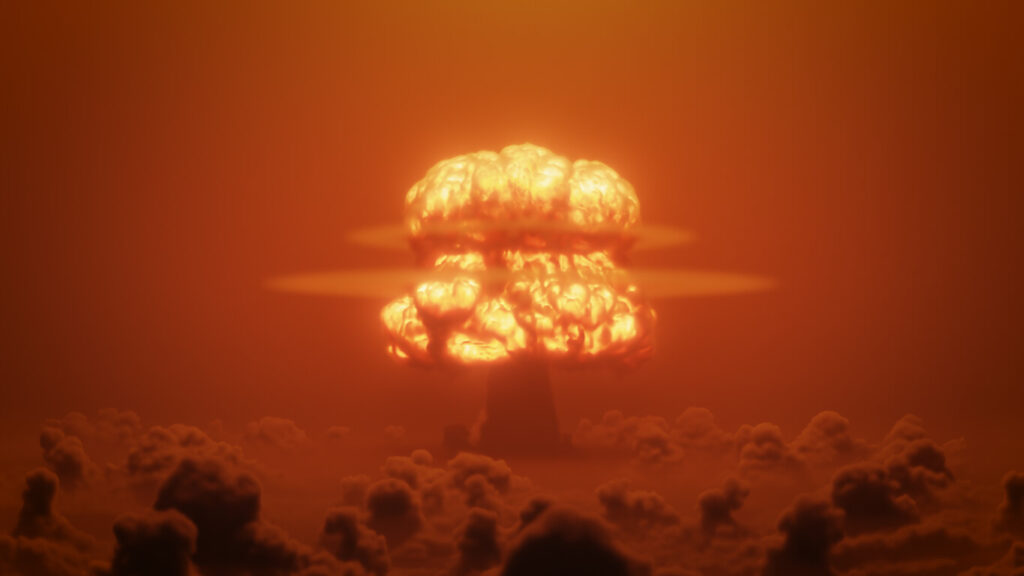
Atmospheric nuclear tests released radioactive fallout that contaminated air, food, and water, causing lasting cancer risks for millions of Americans who lived downwind of test sites.
- Radiation damages DNA: Radioactive isotopes from nuclear fallout enter the body and trigger the genetic mutations that cause cancer.
- Certain cancers are more common: Thyroid cancer, leukemia, and more than a dozen other malignancies are directly linked to fallout exposure.
- Compensation may be available: Eligible individuals may qualify for up to $100,000 through the federal Radiation Exposure Compensation Act (RECA).
Atmospheric nuclear tests, conducted throughout the Cold War era, did not just reshape global politics. They quietly reshaped the health of millions of ordinary Americans. From the 1940s through the early 1960s, the United States detonated more than 200 nuclear weapons above ground, primarily at the Nevada Test Site and across Pacific Island territories.
The fallout from those explosions traveled hundreds, sometimes thousands, of miles. It settled on farms, water supplies, and neighborhoods. People breathed it in. They drank it in their milk. Many of them never knew.
Decades later, communities living downwind of these test sites, known as Downwinders, continue to face elevated cancer rates. Understanding exactly how this exposure leads to cancer is essential for protecting your health, accessing the right screening, and knowing whether you qualify for cancer benefits and federal compensation.
How Did Atmospheric Nuclear Tests Release Dangerous Radioactive Material?
When a nuclear weapon detonates above ground, the explosion sends a massive cloud of radioactive particles into the atmosphere. These particles do not stay in one place. Wind currents carry them across vast distances, where they eventually settle onto the ground, crops, and water sources. This process is called radioactive fallout.
The U.S. Environmental Protection Agency (EPA) identifies several radioactive isotopes released during atmospheric nuclear tests, including iodine-131, cesium-137, and strontium-90. Each of these isotopes behaves differently inside the human body and poses its own distinct cancer risks.
Communities in Arizona, Idaho, Nevada, New Mexico, and Utah received the heaviest concentrations of fallout during the testing period, which ran primarily from 1951 to 1962. Fallout contaminated soil and vegetation, which then entered the food chain through livestock. People who consumed dairy products and fresh produce from affected areas absorbed radioactive particles into their bodies without any awareness of the danger.
How Do Radioactive Isotopes from Nuclear Fallout Enter the Body?
Radioactive particles released by atmospheric nuclear tests enter the human body through three main pathways.
- Inhalation: People breathe in contaminated air and dust, depositing radioactive particles directly into the lungs.
- Ingestion: Contaminated food and water carry radioactive isotopes into the digestive system, where they are absorbed into the bloodstream.
- External exposure: Direct contact with contaminated soil, surfaces, or the fallout cloud itself can expose skin and underlying tissue to radiation.
Once inside the body, each isotope migrates to specific organs. Iodine-131, for example, travels directly to the thyroid gland because the thyroid absorbs iodine to produce hormones. The thyroid cannot distinguish between stable iodine and radioactive iodine-131, so it absorbs the radioactive version just as readily.
Strontium-90 behaves similarly to calcium and is absorbed into bones and bone marrow. Cesium-137 distributes throughout muscle tissue and organs.
This targeted accumulation means radiation exposure is not uniform throughout the body. Specific organs receive concentrated, sustained doses, which is why certain cancers appear far more frequently in exposed populations than others.
How Does Radiation from Atmospheric Nuclear Tests Actually Cause Cancer?
Radiation causes cancer by damaging the DNA inside human cells. Specifically, ionizing radiation, the type released by nuclear fallout, carries enough energy to break chemical bonds within DNA molecules.
The human body repairs most DNA damage effectively. However, when exposure is significant or prolonged, some damage goes unrepaired or is repaired incorrectly. These errors are called mutations. When mutations occur in genes that regulate cell growth, cells can begin dividing in an uncontrolled way. Uncontrolled cell division is the biological foundation of cancer.
A 2024 study published in JCO Global Oncology by Rohan Patel, MD, of Case Western Reserve University documented these mechanisms in detail among Pacific Island populations exposed to nuclear testing.
The study confirmed that ionizing radiation causes oxidative stress and double-stranded breaks in DNA, which can result in somatic mutations and, over time, a range of cancers including lung cancer, leukemia, lymphoma, thyroid cancer, and breast cancer. The study also noted that genetic damage can affect progenitor cells, meaning health consequences can carry across generations.
Different types of radiation damage tissue in different ways.
- Alpha particles cause DNA damage but cannot penetrate intact skin, making ingestion and inhalation the primary dangers.
- Beta particles penetrate a few millimeters of tissue, damaging mucosal surfaces, skin, and hair follicles.
- Gamma radiation is highly penetrating and can affect deep internal organs.
- Neutrons, released during nuclear detonations, can make previously non-radioactive materials radioactive, compounding long-term exposure risks.
What Types of Cancer Are Linked to Atmospheric Nuclear Tests?
Atmospheric nuclear tests have been associated with a wide range of cancers. The federal government formally recognizes the following malignancies as presumptively linked to Downwinder radiation exposure under RECA:
- Leukemia (excluding chronic lymphocytic leukemia)
- Multiple myeloma
- Lymphomas (excluding Hodgkin’s disease)
- Thyroid cancer
- Breast cancer
- Lung cancer
- Colon, stomach, esophageal, and pharyngeal cancers
- Pancreatic, bile duct, and gallbladder cancers
- Salivary gland, urinary bladder, brain, and ovarian cancers
- Primary liver cancer (except where cirrhosis or hepatitis B is present)
- Small intestine cancer
Thyroid Cancer
Thyroid cancer is one of the most thoroughly documented consequences of atmospheric nuclear testing. Because the thyroid gland actively absorbs iodine, radioactive iodine-131 concentrates there in dangerously high amounts.
Leukemia
Leukemia, particularly acute forms, develops when radiation damages bone marrow — the tissue responsible for producing blood cells. Bone marrow is extraordinarily sensitive to radiation.
Research published in the Journal of the American Medical Association found a significant association between high levels of nuclear fallout exposure and leukemia deaths in children living in southwestern Utah. The latency period for radiation-induced leukemia is typically five to 10 years, meaning cases often emerged years after the testing stopped.
Lung Cancer
Lung cancer risk increased among Downwinders who inhaled radioactive particles during fallout events. Particles deposited in lung tissue caused sustained, localized radiation exposure to sensitive respiratory cells. Farmers, ranchers, and outdoor workers who spent significant time in contaminated environments faced compounded lung exposure risks.
Who Is at the Highest Risk for Cancer From Atmospheric Nuclear Tests?
Not everyone exposed to fallout faces the same level of risk. Several factors determine individual cancer risk from atmospheric nuclear tests.
Children and Adolescents
Children are significantly more vulnerable to radiation damage than adults. Growing bodies have rapidly dividing cells, which are more susceptible to DNA damage. A child’s thyroid gland also absorbs iodine more aggressively than an adult’s, increasing radioactive iodine-131 uptake.
Research consistently shows that younger age at the time of exposure correlates with higher lifetime cancer rates, particularly for thyroid cancer and leukemia.
Geographic Location
Communities located directly downwind of the Nevada Test Site received the highest radiation doses. This includes areas in Arizona, Idaho, Nevada, New Mexico, and Utah.
However, fallout reached every state in the continental United States, meaning measurable contamination existed far beyond the immediate test zones.
Dietary Exposure
People who consumed large quantities of locally produced dairy and fresh produce during the testing period absorbed significantly higher doses of radioactive iodine and other isotopes.
The Centers for Disease Control and Prevention (CDC) acknowledges that radioactive materials can remain in the body for years, continuously exposing surrounding tissue to low-level radiation.
Pacific Island Populations
The United States conducted 67 nuclear tests in the Marshall Islands between 1946 and 1958 alone. Pacific Islander communities, who lived near testing sites with inadequate protective measures in place, experienced immediate health consequences like burns, hair loss, and radiation sickness, as well as long-term increases in cancer rates, birth defects, and genetic disorders.
Can You Receive Compensation if Atmospheric Nuclear Tests Caused Your Cancer?
If you or a loved one lived in a designated area during the testing period and later developed one of the covered cancers, federal compensation may be available through the Radiation Exposure Compensation Act (RECA).
RECA was originally enacted in 1990 as a formal acknowledgment of the government’s responsibility for harm caused by nuclear weapons development. The program was expanded and extended by Congress in July 2025. Under the current program, eligible claims must be filed by December 31, 2027.
Compensation amounts under RECA are structured as follows:
- Downwinders: $100,000 for individuals who lived in designated counties in Arizona, Idaho, Nevada, New Mexico, Utah, and other affected states during the testing period and later developed a covered cancer.
- On-site participants: $75,000 for individuals who worked at nuclear test sites.
- Uranium workers: $100,000 for workers who developed lung cancer or specific respiratory conditions.
To qualify as a Downwinder, applicants must demonstrate physical presence in a designated county for a minimum of two years during the relevant testing period, generally January 21, 1951, through October 31, 1958, or the entire month of July 1962.
The application process requires documentation of residency, such as tax records or school records, along with certified medical records confirming a covered cancer diagnosis. Because the paperwork can be complex, many applicants benefit from working with cancer help organizations that specialize in RECA claims.
Find Out if You Qualify for Cancer Benefits from Atmospheric Nuclear Tests
Living downwind of a nuclear test site was not a choice. The health consequences that followed were not either. If you developed cancer after potential exposure to radioactive fallout from atmospheric nuclear tests, you deserve to know your legal rights and your options.
The National Cancer Benefits Center is one of the leading cancer help organizations dedicated to guiding Downwinders and Department of Energy workers through the RECA claims process. Our team understands the medical documentation requirements, the legal eligibility criteria, and the steps needed to file a successful claim before the December 31, 2027, deadline.
Contact the National Cancer Benefits Center at (800) 414-4328 or submit a request for a consultation online. Operators are available 24/7 to take your call. There is no obligation to speak with them, and the information you receive could change the course of your health and your financial future.
